


By Rafi Moshe, founder of StoriedLife.

Yes. If you take one thing from this article, take this: record your parents’ voice while you still hear it every day, because the day you want it back is the day you discover how little of it memory actually kept. You know that voice better than almost any sound in your life. Your mother calling you from another room. Your father’s laugh arriving before the punchline. The way they say your name when they want your attention. It feels permanent because it is familiar. Familiarity is not permanence, and the gap between the two is what this article is about.
What a voice carries that words cannot
A written story tells you what happened. A voice tells you who it happened to.
A transcript of your father describing how he met your mother gives you the facts in order. His voice gives you the laugh when he gets to the part he always laughs at, the pause before the detail he has never told anyone, the impression he does of his own father. None of that survives being typed. It is not decoration on the story. For the people who love him, a large part of the story is exactly that.
This is why a recording can stop a room. You are not just receiving information about a person. You are in the presence of them, in the one form that everyday life gave you for free and never warned you it would take back.
The familiarity trap
Nobody thinks to memorize their parent’s voice, for the same reason nobody memorizes a familiar street. It is simply there, every day, unremarkable.
Try a small test. Recall your father’s voice saying something he has not said in years. Not the words, the sound of it. Most people find they can summon a phrase or two, the greatest hits, and then it thins out. The rhythm goes first. Then the exact laugh. What memory keeps is a summary, and it keeps editing the summary.
That is not a failure of love or attention. It is how memory works, and it is precisely why a recording matters. A recording does not summarize. It keeps the thing itself.
You do not know which memories you will want back
When families think about what to preserve, they reach for the documented life: births, weddings, jobs, addresses, the family tree. Those matter. But ask people what they actually wish they had kept, years later, and it is rarely a date. It is the small, specific things. The story about the first job. The explanation of a tradition nobody ever questioned. The way their mother described the bedroom she grew up in. The joke that only works in their father’s delivery.
A photograph can hold a face. A voice recording of the person explaining that photograph holds the person. The car in the picture is a fact. What he thought of the car, who sold it to him, and what went wrong on the drive home is the memory, and it only ever existed out loud.
A recording is not the same as a conversation
Here is the part we learned the hard way, and it is the reason StoriedLife exists.
Before StoriedLife, there was an experiment called LifeDox: a simple tool that let a person record their story at the push of a button. Rafi tested it on the person he most wanted to preserve, his own father. It produced six and a half hours of footage. What it did not produce was a story. Left alone with a record button, his father did what most people do. He said what was safe, what was easy, what sounded like the official version, and he stopped.
A voice matters. But a voice alone, talking to a machine, gives you the press release of a life. The stories live one question deeper, in the follow-up nobody asks a recording: wait, tell me more about that. Who was she? What did the room look like? Why did you never go back?
So record the voice, yes. And whenever you can, record it mid-conversation, with someone listening, reacting and asking the second question. That is where a parent stops performing their life and starts telling it.
How to record your parents’ voice without making it a production
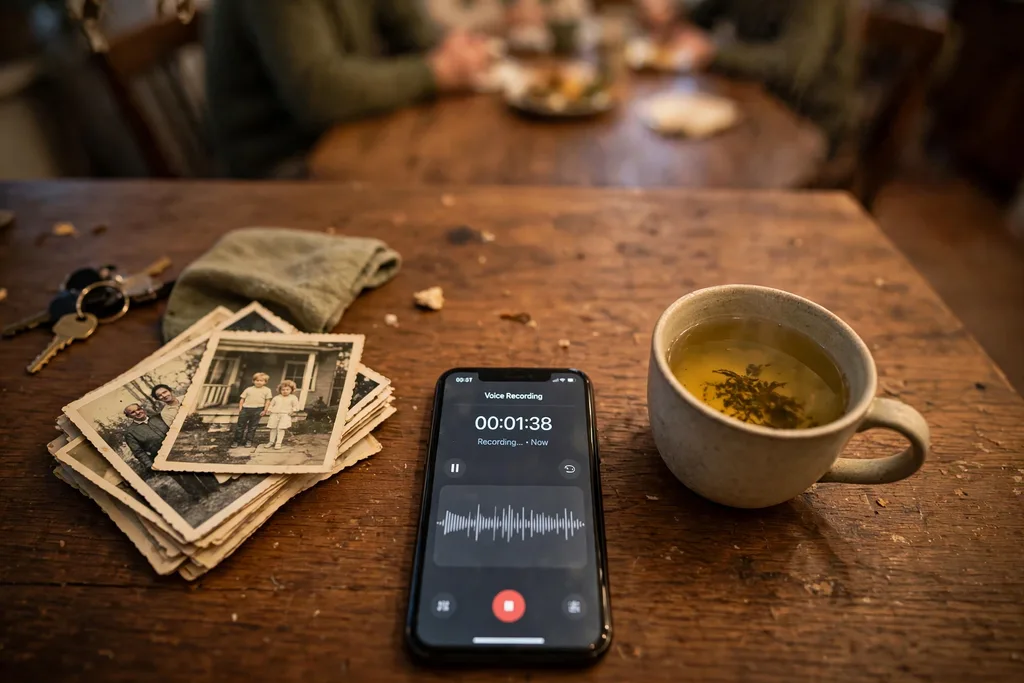
You do not need equipment, a quiet studio, or a plan for a memoir. You need a phone and ten unhurried minutes.
- Start with one specific thing. Not “tell me about your life.” Ask about the house they grew up in, their first job, or the story behind one old photograph. Specific questions get voices going; big ones shut them down.
- Use the voice memo app already on your phone. Put the phone face down between you so it stops being an audience. Sound quality from a normal conversation distance is fine. This is not a podcast.
- Ask one follow-up. When they mention a person, a place or a near miss, ask about that. The follow-up is where the rehearsed version ends and the real one begins.
- Stop while it is still enjoyable. Ten good minutes beat an exhausting hour. You want them glad to do it again next week.
- Save it in two places, with a label. A recording called “Voice Memo 214” is a recording you will lose. Name it with the person, the topic and the date, and keep a copy somewhere other than the phone.
Do this a handful of times and you will have something no archive can give your grandchildren: their great-grandparent, mid-laugh, telling it themselves.
If you want help choosing the tool itself, our comparison of the apps for recording family stories walks through the options, free and paid.
Where StoriedLife fits
StoriedLife starts from the same belief as this article, that the telling matters, and it keeps the voice in both of the ways a family could want.
With StoriedLife, a parent talks with Eva, an AI biographer who listens, follows up in the moment and keeps the conversation going across sittings. Those conversations become written stories that keep the teller’s own phrasing, humour and way of putting things, and each story is also narrated, so the family can hear it read aloud. And the original recording is kept too: the family can listen to the actual conversation, and hear the story in the person’s own voice, pauses, laughter and all, not just in the finished telling. The stories are yours, to keep and download.
That pairing is the point. The voice memo habit above is still worth having for the moments that happen outside any platform, in cars and kitchens. But a drawer of unlabeled recordings and a set of stories are different things, and the families who come to us usually want both in one place: the written story they can hold in a book, and the voice that told it.
What nobody can do, with any tool, is start yesterday. Rafi’s father has been telling his stories to Eva for over a year now, at his own pace, a few at a time. The families who get the most from any of this are simply the ones who began.
The simplest way to begin is a single conversation. You can try a free conversation with Eva, or start with 3 free stories and hear what comes back in your parent’s own voice.
Questions about recording a parent’s voice
What is the best way to record your parents’ voice?
The voice memo app on your phone, placed face down between you during an ordinary conversation. Ask about one specific memory, follow up once or twice, and keep it short. A natural ten minutes recorded this month is worth more than a formal interview you keep postponing.
What should I ask them to talk about?
Start where memory is strongest: the house they grew up in, a first job, how they met your other parent, a photograph they love. Avoid opening with their whole life story. One doorway memory usually opens three more.
My parent hates being recorded. What can I do?
Make it smaller and more casual. Record during a drive, a walk, or looking through photos, with the phone out of sight and permission given. Many people who freeze in front of a recorder forget it entirely mid-story. If they say no, respect it and try conversation without recording; some of the value is in the hearing, and trust outlasts any single session.
Is a transcript as good as a recording?
It keeps the words, and words matter, but it loses the laugh, the pause and the emphasis that make the words theirs. If you can only have one, take the recording. A transcript can always be made from it later. The reverse is not true.
Sources and how we checked
- The LifeDox experiment and its six and a half hours of footage are from Rafi’s own account of building StoriedLife, told in his interview on the Senior Safety Advice podcast (September 2026): https://www.youtube.com/watch?v=U-DPlpulxN8
- What StoriedLife keeps (the written stories, the AI narration of each story, and the original recording of the conversation itself) was confirmed by Rafi Moshe, StoriedLife’s founder, on 26 October 2026.
- Checked 26 October 2026.