


By Rafi Moshe, founder of StoriedLife
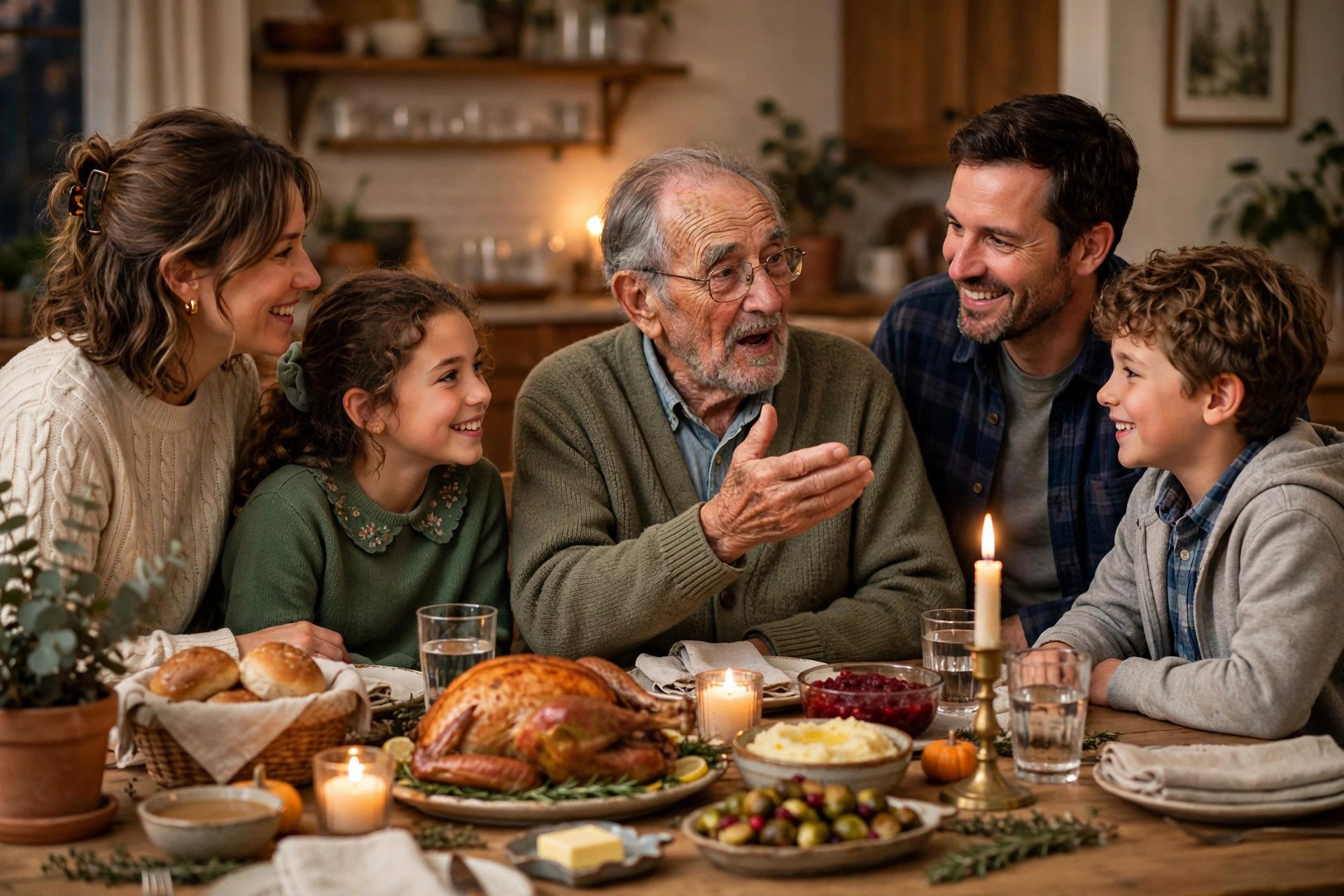
If you are hosting this year, here is the honest version: a meaningful Thanksgiving almost never fails because of the food. It fails because the day fills up with cooking, seating and football, and the one thing everyone secretly hoped for, hearing the family’s stories told out loud, never gets a moment of its own. Hosting fixes that, and it does not take a programme or a speech. It takes three decisions made before the day: pick one story moment and protect it, give your oldest guest a role instead of an audience, and decide in advance how the family keeps what gets told. That is the whole method in this article, with what we learned this fall from testing our own Thanksgiving evening four times end to end.
Full disclosure: the Thanksgiving Gathering experience described below is a StoriedLife product, free to play. The hosting method stands on its own without it.
The short version: a meaningful Thanksgiving in three decisions
If you only read one section, read this one. Protect one story moment: choose it before the day, put it where people are relaxed, and announce it in the invitation so nobody is ambushed. Give your oldest guest a role, not a spotlight: asked ahead, subject of their choosing, a photograph or an object in their hands. And decide how the family keeps what gets told, because a story with no home fades by January. Everything below is those three decisions, worked out in host order.
When is Thanksgiving 2026?
Thanksgiving in the United States falls on Thursday, November 26, 2026.
| Year | Date |
|---|---|
| 2026 | Thursday, November 26 |
| 2027 | Thursday, November 25 |
| 2028 | Thursday, November 23 |
It is always the fourth Thursday of November, which matters if you are the host: the date moves, the rhythm of the day does not. Everything below is planned backwards from that Thursday.
What we learned from four test Thanksgivings
This fall we built a Thanksgiving Gathering experience: the host opens it on one phone, Eva deals conversation cards and guides the table through them, and the night becomes a printed family book with everyone’s voices and photos. Before it went live, we played the whole evening through four times, landing page to finished book to print order, and fixed what broke. Three lessons from those evenings changed how I would host any Thanksgiving, with or without a phone on the table.
The evening can pause. Dinner interrupts stories, and that is fine. An evening that can stop for the turkey and pick up again at dessert keeps its energy. An evening that demands one formal sitting, everyone silent, one person performing, loses the room by the second course.
The table picks better questions than the deck does. When we let a table choose a card, or write its own question, the talk ran longer and went somewhere real. A dealt question that lands flat should be swapped without ceremony. The question is a door, not an assignment.
One phone is enough, a second one helps. The host’s phone can run the whole night. When a second phone joined, guests added their own photos as the stories were told, and the kids put their drawings on the page they had picked. The keepsake built itself during the evening instead of becoming a job for the week after.
Decide the story moment before you decide the menu
Most hosts plan the day around the turkey, and the stories are left to chance, usually to the gap while the bird rests, when half the table is clearing plates. Pick the moment first and build the day around it. For most houses, one of two windows works.
The kitchen hour, while dinner is cooking and people drift in and out, suits small talk that turns real: a photo on the fridge, a recipe with a history, the story of a dish. The slow hour after dessert is better for the bigger stories, when nobody is holding a hot pan and the kids are still just about awake.
Then say it in the invitation. One line is enough: after dinner, we are asking Dad about the first Thanksgiving he remembers, and anyone who has a photo from a family Thanksgiving should bring it. That line does three jobs. It gives your storyteller time to think, and people tell better stories with a day’s notice. It tells everyone else the moment is coming, so it does not feel like an ambush or an interview. And it gives guests a small, easy contribution to make, which changes them from audience to participants.
Give the oldest guest a role, not a spotlight
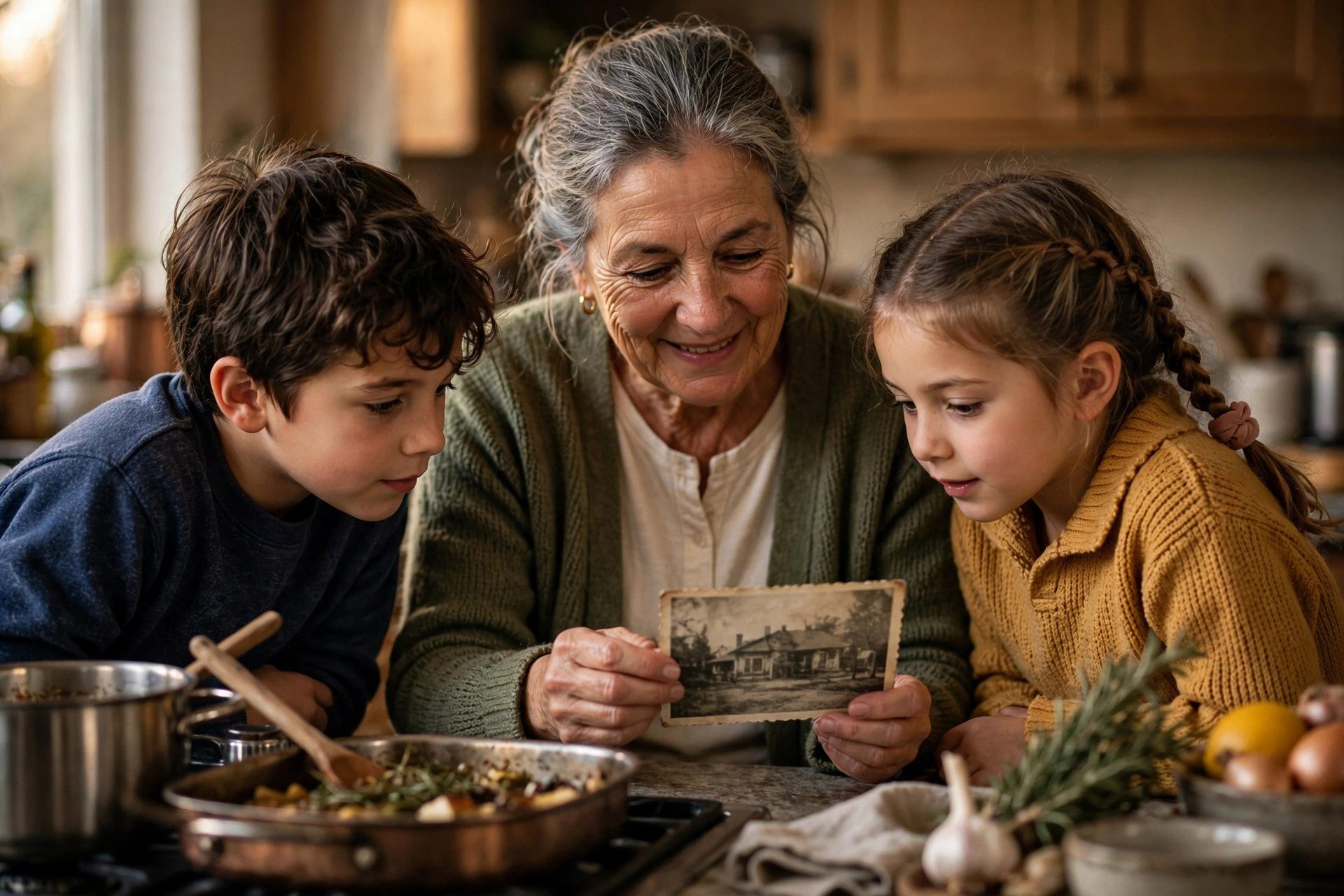
Being asked to perform in front of the whole table puts many grandparents off, even ones with wonderful stories. A role is different. Ask them a few days ahead, let them pick the subject, and give them something to hold. An object or a photograph does most of the work: research on photo elicitation, talking through pictures, has found that photographs change how people recall events, pulling up details and other people’s versions along with the memory itself.
The lowest pressure version we publish is the five photograph activity: five old family photographs on the table before dinner, and each one starts a conversation. One photograph can carry the whole afternoon, and that counts as success. We wrote it up in full in our guide to Thanksgiving activities for families, and it pairs well with this hosting plan: the photographs open the day, the story moment after dessert goes deeper.
Two small seating choices help. Put your storyteller in the middle of the table, where they can be heard without raising their voice, not at the far end past the football talk. And seat a grandchild beside them rather than at a separate kids’ table across the room. The questions children ask are the ones adults have stopped asking, and being asked is what turns a role into a pleasure.
One question, asked well, beats twenty questions
Hosts worry they need a list. You need one good question and the patience to follow where it goes. Ask about a place or an object before you ask about an event: the house they grew up in, the first car, the job they had at seventeen. Scenes come back with detail. Dates and names can be filled in later, by anyone.
If you want backup, the free Thanksgiving conversation starter cards carry 41 questions sorted for a mixed age table, and the printable version arrives by email if you would rather keep phones away from the table entirely. Use them the way the test evenings taught us: deal one, and if it lands flat, let the table pick another.
And hand one of your other jobs away. A host who is carving, pouring and clearing cannot also be the person who notices that Aunt Rosa started a story and got talked over. Listening is a job at a story sharing table. Give the carving to someone else, or accept help you would usually wave off, and keep the listening for yourself.
Keep what gets told
A story told once at a table fades the way dinner conversation does. Decide before the day how yours will be kept, and the deciding takes a minute.
The Gathering route: the host opens the Thanksgiving Gathering on one phone, Eva deals the cards and guides the table, it can pause while you eat, and at the end of the night the stories, voices and photos are already gathered into a family book the host can order in print. Nothing to transcribe, nothing to chase.
The paper route works too. Put a notebook by the coffee pot and ask one person, not everyone, to write down the stories that landed, a few lines each, while the details are fresh. Photograph the old pictures that came out, with the story written under each one, the way the five photograph activity ends. Either way, send one story back to the family chat the next day. That message, more than the book, is what makes people ask for a repeat next year, and it is how one Thanksgiving turns into a family habit rather than a nice idea. If a grandparent leaves you wanting the longer version of their story, that is what Eva’s one to one conversations are for afterwards: sign up for the full app experience and let them tell it properly, at kitchen table pace.
By Rafi Moshe, founder of StoriedLife.
Questions hosts ask us
When is Thanksgiving in 2026?
Thanksgiving in the United States is on Thursday, November 26, 2026. It falls on the fourth Thursday of November each year: Thursday, November 25 in 2027 and Thursday, November 23 in 2028.
How do I get my grandparents to tell stories at Thanksgiving?
Give them a role, not a spotlight. Ask a few days ahead, let them choose the subject, and put a photograph or an object in their hands. Ask about a place, the house they grew up in, before an event. One good question, followed with real curiosity, will do more than a list of twenty.
What if my family thinks a story activity sounds awkward?
Do not announce an activity. Announce one question, after dessert, and keep it short enough that anyone can pass. In our test evenings the tables that chose their own question settled in fastest. Awkwardness usually lasts one answer; by the second story, people are correcting each other’s details, which is the sound of it working.
How long should the story part of the evening take?
Twenty to forty minutes is plenty for a first year, and it does not need to happen in one sitting. The kitchen hour produces small stories while dinner cooks, and the slow hour after dessert holds the bigger ones. A moment that can pause for dinner and resume afterwards keeps everyone, including the storyteller, fresh.
Can kids take part, or is this an adults’ table thing?
Kids belong in it. Their questions are often the best ones, and in the Gathering they can join from a second phone, add photos as stories are told, and put their own drawings into the family book. Seat at least one grandchild beside the storyteller and watch what happens.
What will we have to keep after the night ends?
That depends on the route you chose before the day. With the Thanksgiving Gathering, the night’s stories, voices and photos are gathered into a family book the host can order in print. On paper, a notebook of the stories that landed, plus the old photographs copied with their stories written underneath, gives you the same keepsake in rougher form. Either beats relying on memory by January.
Sources and method
The hosting method in this article comes from building and testing the StoriedLife Thanksgiving Gathering: four complete test evenings played end to end, from the landing page to the finished book and print order, in October 2026. The research on photographs and recall is cited from the published studies below. Product details were checked against storiedlife.ai and the live app pages on November 4, 2026. In line with our content plan, this post states no prices.
King, C. I., Panjwani, A. A., and St. Jacques, P. L., “When having photographs of events influences the visual perspective of autobiographical memories,” Applied Cognitive Psychology: https://doi.org/10.1002/acp.4150
Fawns, T., “Cued recall: Using photo-elicitation to examine the distributed processes of remembering with photographs,” Memory Studies, 16(2), 2023: https://doi.org/10.1177/17506980211073093
StoriedLife, Thanksgiving activities for families (the five photograph activity): https://storiedlife.ai/post/thanksgiving-activities-for-families/
StoriedLife, Thanksgiving Gathering: https://app.storiedlife.ai/experiences/gathering/thanksgiving?lang=en and the conversation starter cards: https://app.storiedlife.ai/questions/thanksgiving-conversation-starters?lang=en
Checked November 4, 2026.