


By Rafi Moshe, founder of StoriedLife
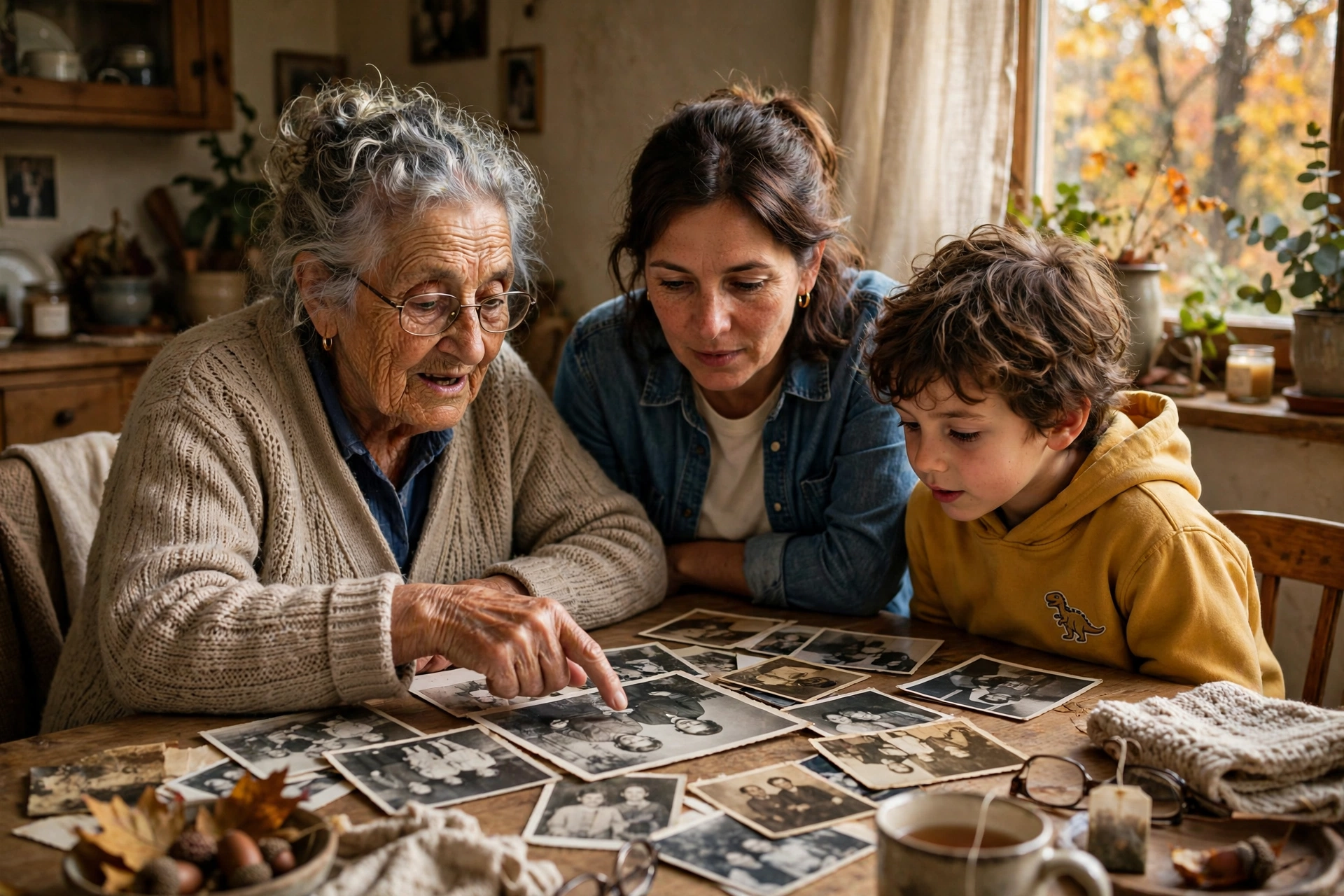
If you are looking for Thanksgiving activities for families that a grandparent can join as fully as a grandchild, try this one. Before dinner, choose five old family photographs and put them on the table where everyone can see them. Then let each photograph start a conversation. That is the whole activity. No craft supplies, no printed game cards, no app to download, and nothing to rehearse. The oldest person at the table usually becomes the most important person in the room, because they are the only one who knows what the photographs cannot show.
Here is why it works, how to run it without turning it into a homework assignment, and how to keep the stories your family finds instead of losing them by dessert.
How the five-photo activity works
Pick the photographs before everyone arrives, and pick them for range, not for importance. Five wedding and graduation portraits will give you five polite conversations. A childhood home, a first car, a relative at work, someone young in clothes nobody would wear now, and one photograph nobody can quite place will give you an afternoon.
1. Start with what everyone can see. Open with the scene, not with a memory test. Ask what it was like living in that house, or what usually happened after school, rather than demanding names and dates. Describing what is in front of them gives your relative somewhere easy to begin.
2. Follow the detail that surprises you. The first answer usually just identifies the picture. The story is in the next detail: the neighbour who always visited, the job someone saved up from, the reason the family moved. When something catches your attention, ask about that. You do not need a prepared list of follow-up questions. Genuine curiosity does the work.
3. Let other people add their version. A younger relative will notice things an older one stopped seeing years ago, an unfamiliar appliance, an outfit, a car. Let them ask. When two people remember the same day differently, note both versions and move on. Settling who is right can wait, and interrupting a story to fact-check it is the fastest way to end it.
4. Do not rush to finish all five. One photograph might carry the whole afternoon. That is a success, not a failure. The goal is one story worth keeping, not a completed activity sheet.
5. Keep the story with the photograph. Before the day ends, write down what you learned while it is fresh: who is in the picture, roughly when it was taken, and the story that came with it. Mark anything uncertain as uncertain. A guess written down confidently has a way of becoming family fact within a year.
Why a photograph works better than a question
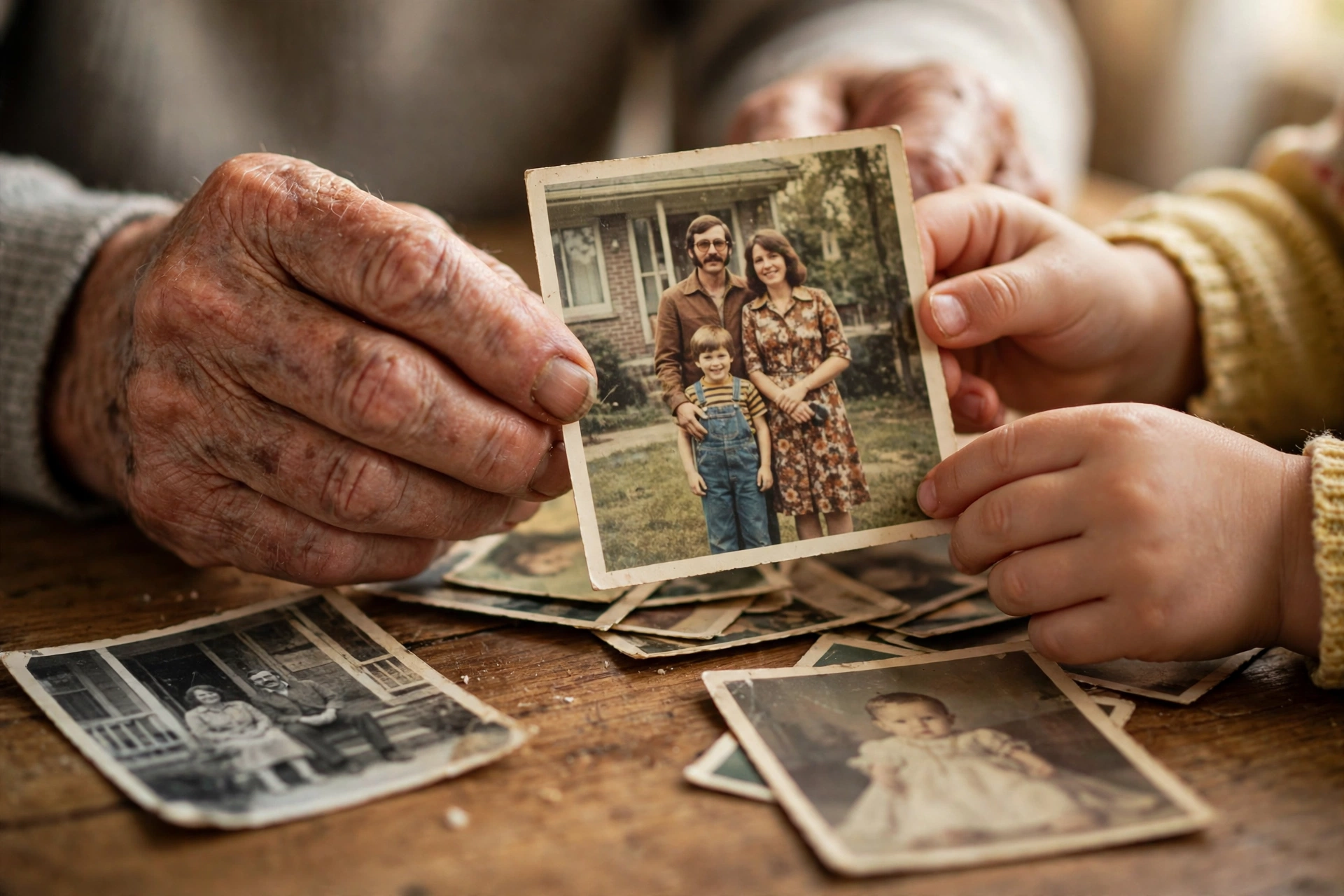
Ask someone to tell you about their childhood and you will often get a summary. Show them the house they grew up in and you get the kitchen window, the room they shared, and the neighbour who dropped by without calling. The photograph gives memory somewhere specific to land.
There is real research behind this, and it cuts in an interesting direction. In three studies with 378 participants, researchers Chloe King, Azra Panjwani and Peggy St. Jacques at the University of Alberta found that when people had photographs of an event that showed themselves in the scene, they were more likely to remember that event from an observer’s perspective, almost as if watching themselves in it, compared with events whose photographs did not include them. In other words, photographs do not simply preserve our memories. They can quietly reshape them.
That is worth knowing at a family table, for two reasons. First, it means the photograph is not the memory. Everything that makes the moment mean something, who took it, what happened just before, why everyone was there, lives in the people looking at it, and most of that is never written on the back. Second, it means the conversation around the photograph is not small talk. It is where the actual record gets made.
Tim Fawns, a researcher at the University of Edinburgh, makes a related point in his work on photo-elicitation. He argues that photographs are not just cues that trigger a memory stored somewhere in one person’s head. They are objects a group builds an account of the past around, with the photograph, the recollections and the conversation all contributing. Anyone who has watched three relatives construct three different versions of the same holiday, and end up with a fourth version richer than any of them, has seen this happen.
The details nobody thinks are interesting
Albums are full of the big occasions, and the big occasions are rarely where the good material is. Weddings and graduations photograph well, but they do not tell a grandchild what daily life actually felt like.
Rafi has made this point in his podcast conversations about StoriedLife: what younger generations lean in for is the small stuff. The pranks someone pulled as a kid. The clothes they wore. The family dish that only one person makes properly, with the two ingredients nobody else seems to use. To the person who lived it, these details feel too ordinary to mention. To a grandchild, they are the difference between knowing a grandparent’s biography and actually having a sense of the person.
So when a photograph of an ordinary kitchen starts a story about who cooked there and what was always on the stove, do not steer back to something more important. There is nothing more important. That is the story.
Keep the story with the photograph
A photograph of relatives outside a house looks the same in forty years. What disappears is everything around it: whose house it was, when it was taken, why everyone had gathered. The activity above is how you recover that context while the people who hold it are still at your table.
A few habits make it stick:
- Write the names, the rough date and the story on a note kept with the photograph, or in the photo’s description if it is digital. Include who told you, because “Grandma said the house was sold in 1978” is more useful later than a bare date.
- If two relatives disagree, record both versions with both names. Future family historians, possibly your own grandchildren, will thank you for not silently picking a winner.
- When a photograph raises a question nobody can answer, that is a research job for later, not a dead end. Our guide to tools for researching family history and preserving what you find walks through where to look.
If the photographs themselves need care, choosing which ones to scan, restore and print, the practices in our guide to capturing meaningful memory book photos will help. And if the activity leaves your family wanting more conversations like this one, our list of questions to ask your parents is a good next step that does not require a holiday to start.
When you want to keep going after Thanksgiving
Most families find that five photographs produce more stories than one afternoon can hold. A voice note and a caption are a good start, but they scatter quickly. The story ends up in one app, the photograph in another, and the names in someone’s memory.
This is the gap StoriedLife was built for. It started, honestly, with a mistake: an early experiment asked people to simply record their stories, and hours of footage later there was plenty of recording and very little story. What works is conversation, an interviewer who listens and follows up, asking about the detail someone mentioned in passing. That is what Eva, StoriedLife’s AI biographer, does. A parent or grandparent talks, Eva asks the next question, and the conversation becomes a written, narrated story the family can keep, alongside the photographs that started it.
You do not need any of that to run this activity on Thursday. But if your family leaves the table wishing the stories had somewhere to live, start a free conversation and see what one story becomes.
Questions about Thanksgiving activities for families
What are some meaningful Thanksgiving activities for families that include older relatives?
Activities where the older person is the expert rather than a spectator. The five-photo activity in this article is built exactly that way: the grandparent is the only one who can explain what the photographs show. Storytelling over dessert, cooking a family dish together with the recipe’s history, and going through a family album as a group all share the same quality. Everyone can participate, and age is an advantage rather than a limitation.
How many photographs do we need, and which ones work best?
Five is a good number, and you may only get through two. Choose for variety: a home, a workplace or school, a car or a trip, someone young, and one mystery photo nobody can fully explain. Everyday scenes outperform formal portraits because they hold more of ordinary life, which is where the stories are.
What if my parent or grandparent does not like talking about the past?
Do not frame it as an interview or a project. Put the photographs on the table as something interesting you found, and let them comment as much or as little as they want. Some people who would refuse to “tell their life story” will happily explain who is standing in a doorway and why. If a topic is clearly unwelcome, let it go. The activity only works if it feels like time together.
What if nobody can identify a photograph?
That photograph is not a failure, it is a research prompt. Record what people can work out from clothing, cars, houses and handwriting on the back, mark the rest as unknown, and keep it with the family collection. Census records, old letters and other relatives often fill the gap later, and an honestly unidentified photo is worth more than a confident guess.
How do we keep the stories after Thanksgiving is over?
At minimum, keep each story with its photograph, with names, a rough date and the storyteller’s name attached. If you want the stories themselves preserved as something the family can read and listen to, that is what StoriedLife does: conversations with Eva become written, narrated stories, collected with the family’s photographs.
Sources and how we checked
- King, C. I., Panjwani, A. A., & St. Jacques, P. L. “When having photographs of events influences the visual perspective of autobiographical memories.” Applied Cognitive Psychology. The three-study, 378-participant finding on observer-perspective recall is from the published abstract: https://doi.org/10.1002/acp.4150
- Fawns, T. “Cued recall: Using photo-elicitation to examine the distributed processes of remembering with photographs.” Memory Studies, 16(2), 2023: https://doi.org/10.1177/17506980211073093
- Rafi’s remarks on small details and grandchildren are from his interview on the Senior Safety Advice podcast with Esther Kane (September 2026): https://www.youtube.com/watch?v=U-DPlpulxN8
- Research and sources checked 26 October 2026.