


By Rafi Moshe, founder of StoriedLife.

Prices in this article were last checked in October 2026.
A family keepsake book gets made in five moves, and printing is only the last one. Decide who the book is for. Gather the stories. Gather the photos. Write captions that carry names and dates. Then print it in a format that will outlast the shelf it sits on. Families who start at the printing end up with a handsome book and thin content. Start with the people and the book nearly builds itself.
Decide who the book is for before you open the photo box
One reader, kept in mind, settles a hundred small arguments later. A book for a granddaughter turning eighteen skips the genealogy paperwork and keeps the stories about her grandmother as a young woman. A book for your siblings can carry the harder chapters, the ones about money and feuds and the year nobody talks about. A book for your mother’s eightieth birthday is a celebration and should read like one.
Write the purpose down in a single sentence and tape it to the box of photos. “So the grandkids know who their great-grandparents actually were” is a purpose. Every borderline photo and story after that gets one test: does it serve the sentence?
Gather the stories first, while the storytellers are here
Photos wait patiently in boxes for decades. People don’t. So the interviews come first, before any scanning or sorting.
Ask questions that can’t be answered with yes or no. “Did you like school?” gets you a shrug. “What happened on your walk to school?” gets you the shortcut through the rail yard, the dog that waited at the fence, and the winter the creek froze. The Smithsonian’s oral history interviewing guide makes the same point: open questions, real follow-up questions, and photos used as prompts. Spread the album on the table and let a picture start the story.
Keep the setting ordinary. Kitchen tables produce better stories than formal sittings, and short sessions beat long ones. Twenty minutes after lunch, twice a month, adds up to a book within a year. Record the conversation if the storyteller agrees. You’ll want the recording later, when you’re checking a date or trying to remember exactly how she described the house.
Two ground rules protect the whole project. Sensitive topics get asked about once, gently, and a no is a no. And every contributor reads their own chapter before printing and can strike anything in it. People share more, not less, when they know they hold that veto. If you need a starting list of questions, our 100 questions to ask your parents covers childhood, work, love and the rest, and our guide to preserving family stories goes deeper on the interview itself.
Then gather the photos and the papers
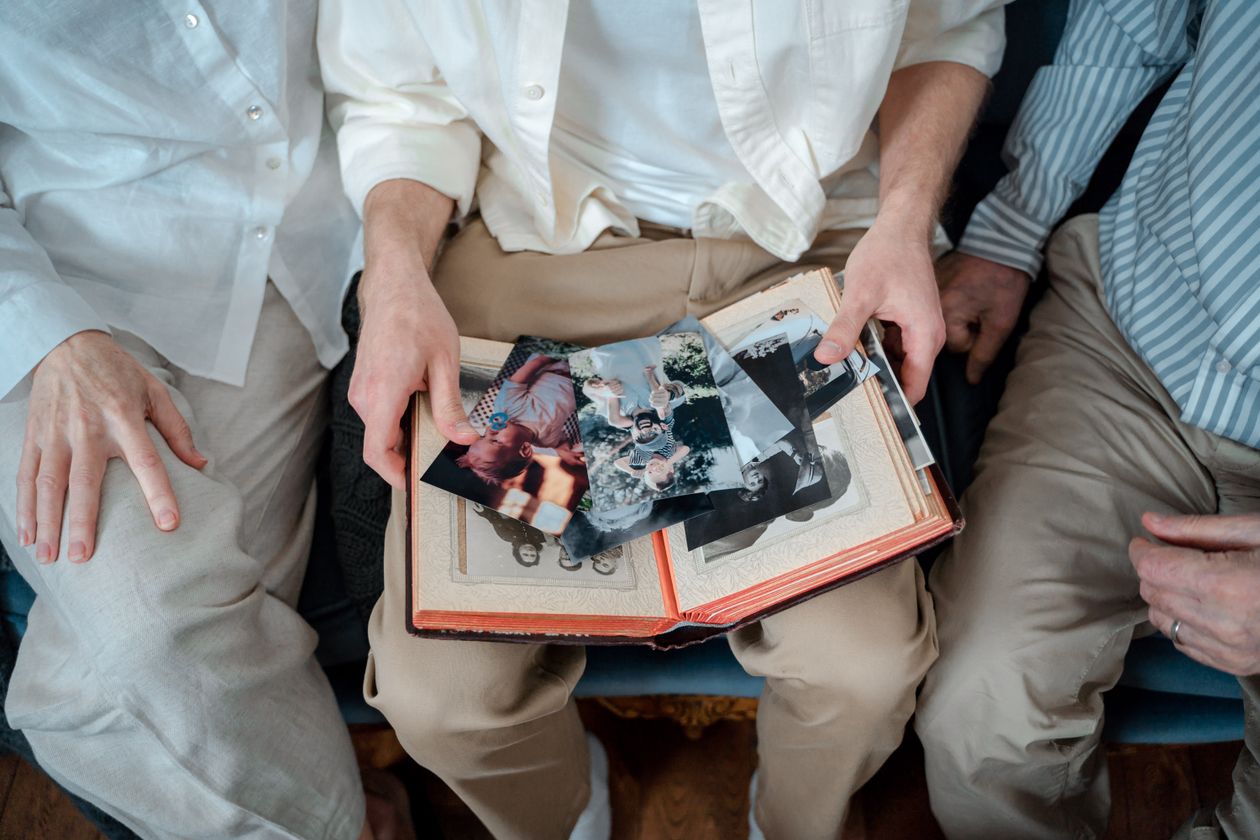
With the stories underway, go through the boxes. You want a mix: portraits, yes, but also the candid shots, the kitchen in 1974, the car nobody would drive today, the everyday rooms where life actually happened. Milestone photos (weddings, graduations) mark the peaks. The ordinary ones carry the texture, and texture is what grandchildren ask about.
Paper matters too. A marriage certificate, a letter home, a report card, a theatre ticket stub. Photograph or scan these flat, in good light, and put the originals back somewhere safe. Documents anchor the stories to dates, and dates are the first thing a family argues about.
Scan prints at a size you’d be happy printing, and keep the digital files in two places, not one. The Library of Congress gives the same advice to families archiving their own photos: pick the keepers, give them descriptive names, and store copies in different locations. A shoebox survives one flood. A single laptop doesn’t.
Captions and dates do the quiet work
Here is the uncomfortable truth about family photos: an uncaptioned photo becomes anonymous within one generation. Your kids know the woman in the garden is your mother. Their kids will not, unless the page tells them.
A good caption carries four things: who, where, when, and the one detail that sits outside the frame. “Mom, Palermo Street garden, summer 1968. The tomatoes she grew because Dad said store-bought had no taste.” That last clause is the one a reader remembers in thirty years.
Dates will fight you. Settle for the year when the month won’t come, and ask the oldest relative first, while asking is still possible. Cross-check against the documents you gathered: the model of the car, a calendar on a kitchen wall, a baby’s age in the photo. Close is fine. Wrong by a decade is not.
One more habit worth stealing from memoir writers: end each chapter with two or three lines from the storyteller, looking back. What do they know now that they didn’t know then? Those short reflections are often the pages readers return to.
Give your family keepsake book a shape a reader can follow
Two structures work. Chronological order tells a life in sequence and suits a book about one person. Themed chapters (childhood, work, the house on Palermo Street, holidays and food) suit a book about a whole family, because readers can dip into the part they care about. Neither is better. Pick the one your named reader will actually finish.
Once the book passes sixty pages or so, add a table of contents. Keep one layout and repeat it: story, photo, caption. Consistency reads as care, and it lets you stop designing and finish. Our family history book guide covers structure choices in more depth if you’re building the bigger, documents-and-all version.
Print quality: the choices that decide how long it lasts
A keepsake book gets handled. It comes off the shelf at holidays, gets passed around a table, and ends up in a grandchild’s hands with jam on them. Four choices decide whether it survives that life.
Cover. Hardcover for the copy that lives in the family room and gets handed down. Softcover is lighter, cheaper, and perfectly good for reading copies.
Paper. Photo-heavy pages want heavier stock so pictures don’t ghost through from the other side.
Files, if you print it yourself. Photos should go to the printer at 300 dpi, and you should hold a printed proof before ordering the run. Read the proof with a pen in hand. Screens hide typos; paper doesn’t. (The print-prep basics are laid out well at Book Design Made Simple, linked in Sources.)
A service that includes the book. With StoriedLife, a book is included at every membership level: a PDF book with Digital at $59 a year, a colour softcover with Storyteller at $98, and a colour hardcover with Keepsake at $118. The included book runs up to 300 colour pages, extra pages cost $15 per additional 100 pages up to an 800-page maximum, and printed books ship in about 7 business days. Our memoir book cost guide breaks down what each route costs across the market.
Plan the copies while you plan the book
Count households, not people. One book in one house means every other house borrows it, and borrowed keepsakes have a way of staying borrowed. Extra copies of a StoriedLife book cost $39 for a softcover and $59 for a hardcover, so a copy for each sibling’s house is a modest line item next to the work of making the book itself.
Two touches turn copies into heirlooms. Write a short note by hand inside the front cover of each copy, and make it different for each person: the recipe only she makes, the story only he tells. And hand the books over at a gathering if you can, not through the mail. The unveiling, with everyone in one room arguing happily about dates, is where the next round of stories gets told. Some of them will belong in the next edition.
If the talking is the hard part
Most keepsake books stall at the same place: a relative who has stories but freezes at a blank page, a recorder, or a list of questions from a well-meaning grandchild. A conversation works where homework doesn’t.
That’s the gap StoriedLife was built for. Eva, our AI biographer, talks with the storyteller in real conversation. She asks a question, listens to the answer, and follows up in the moment, the way a good interviewer does. She remembers what was said in earlier conversations, so the questions get better over time, and she turns the answers into written stories she can also narrate aloud. The stories are organised into chapters, your photos go in beside them, and the finished book is printed as described above. My own father has been telling Eva his stories for over a year now, a few at a time, and the book grew out of conversations he genuinely enjoyed. The first stories are free, and there’s no card to enter. How it works shows the process step by step.
Full disclosure, since this is our blog: StoriedLife is our product. The method in the sections above works with any tools, including a notebook and a phone. We’d rather you made the book than waited for the perfect way to make it.
Start with one conversation. The book begins the moment a storyteller starts talking. Eva asks the questions, follows up, and turns the answers into stories you can keep. The first stories are free, and there is no card to enter. Start a free conversation with Eva.
Frequently asked questions
How many pages should a family keepsake book be?
Most land between 100 and 300 pages: enough room for a full set of stories and photos without turning into a doorstop. With StoriedLife the included book covers up to 300 colour pages, and you can extend it to 800 pages at $15 per additional 100 pages if one storyteller has a very full life to tell.
What should go in a family keepsake book?
Stories first, then photos with captions that name the people, place and year. Add a handful of documents (certificates, letters, a beloved recipe) and short reflections from the storyteller. Skip anything nobody can identify or explain; an unexplained artifact is clutter, even in a book.
How do I get relatives to contribute their stories?
Ask for one story at a time, not a life history. A short conversation after a family meal beats a questionnaire every time. Let each person read and approve their own chapter before printing; that veto makes people noticeably more willing to talk.
Should I organise the book by date or by theme?
By date for a book about one person’s life, since readers follow a life in order. By theme for a book about a whole family, since readers dip into the chapters they care about. Either works if you keep one layout throughout and add a table of contents past sixty pages.
How much does it cost to make copies for the whole family?
It depends on the route. Print shops charge per copy and the price swings with page count and binding. With StoriedLife, the first book is included in the membership ($98 for a softcover plan, $118 for hardcover), and extra copies are $39 for a softcover and $59 for a hardcover.
Sources
Sources, all checked in October 2026:
- Interview method (open questions, follow-ups, photos as prompts): Smithsonian Center for Folklife and Cultural Heritage, education resources including the Folklife and Oral History Interviewing Guide
- Keeping family photos safe (descriptive names, copies in more than one place): Library of Congress, Personal Archiving: Keeping Personal Digital Photographs
- Why family stories matter for children: University of Nevada, Reno Extension, Family Storytelling and the Benefits for Children
- Image resolution for print (300 dpi): Book Design Made Simple, Is Your Image High Enough Resolution for Print?