


By Rafi Moshe, founder of StoriedLife.
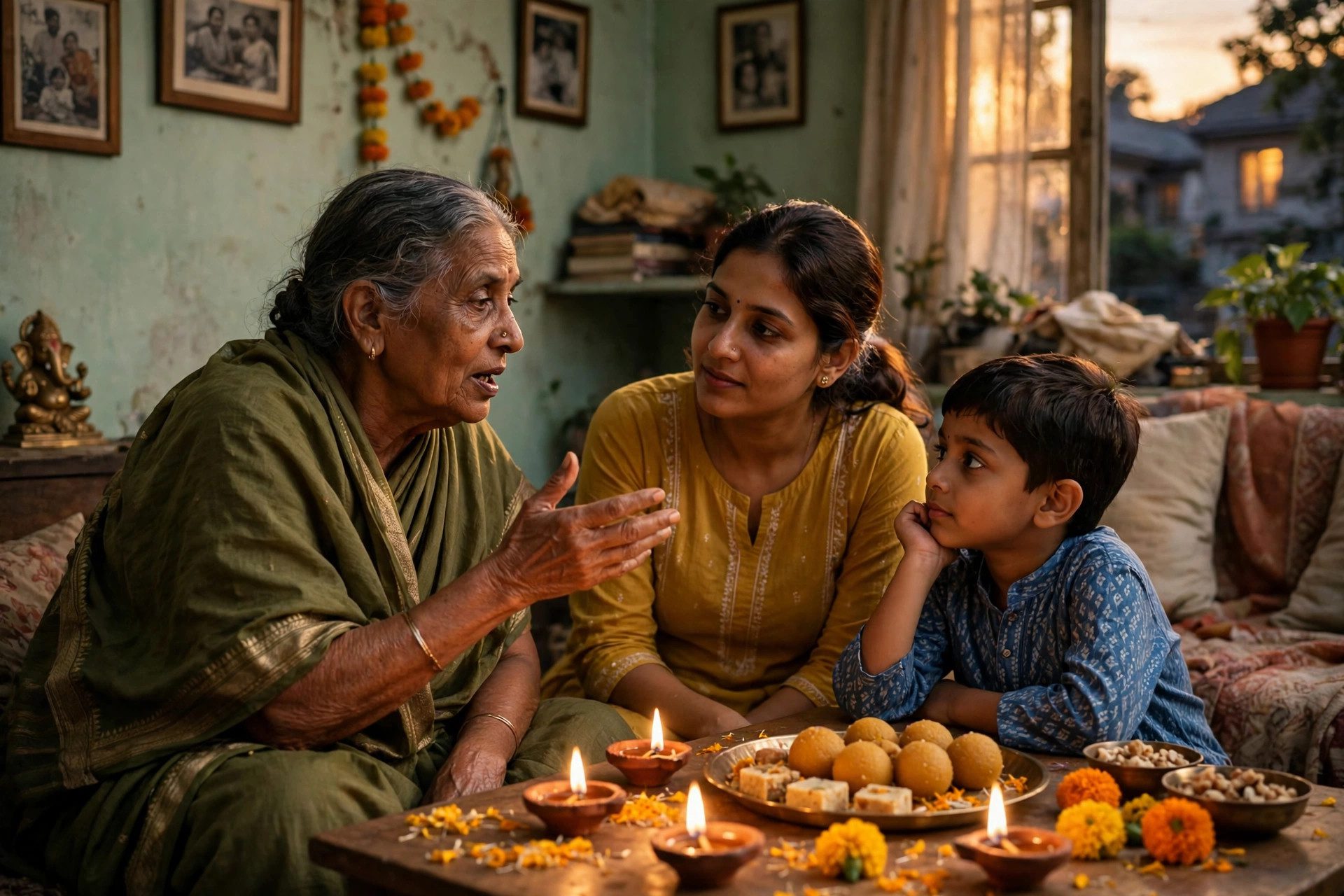
The best Diwali questions for grandparents are not really about the festival. They are about a house that may not exist anymore, a sweet somebody always made, a train journey, a first year in a new country. Diwali gives you the setting for free. The whole family is already gathered, the lamps are lit, and your grandparents are surrounded by the smells and sounds that unlock old memories better than any direct question about “the past” ever will.
This post is a method, not a script. It covers when to ask, how to open without making it feel like an interview, the follow-up questions that turn a one-line answer into a story, and a simple way to keep what they say. The questions are grouped by theme, so you can pick two or three that fit your family instead of working through a list.
Ask in whatever language your family actually speaks at the table. Stories come back with more detail in the language they were lived in, and a grandparent who switches into their mother tongue mid-answer is usually arriving at the good part.
How to ask so it does not feel like an interview
Pick your moment. The middle of Lakshmi Puja is not it. The natural windows are while food is being made, while diyas are being set out, or after dinner when nobody is in a rush to clear up. Storytelling fits around the work of the festival, and hands that are busy rolling, folding or arranging tend to loosen tongues.
Open with a thing, not a topic. Point at the sweet on the plate and ask who made it when they were small. Hold up an old photograph. Ask about the lamp, the courtyard, the street. Objects carry memories in a way that “tell me about your childhood” never does, because the memory is attached to the object and arrives with it.
Then follow up on details. When your grandfather says the whole street shared one string of lights, ask whose house it started at. When your grandmother mentions a neighbour, ask for her name and what she was like. Names, rooms, what things cost back then, the weather, what somebody said word for word: these are the details that make a story worth keeping, and grandparents usually have them ready once they know you actually want them.
One more thing worth saying out loud, early: tell them why you are asking. “I want the kids to know what your Diwalis were like” lands differently from small talk, and most grandparents, once they hear it, stop giving the short version.
Diwali questions for grandparents, grouped by theme
The childhood home
- Walk me through your house on Diwali morning. Which room did everyone end up in?
- Who lit the first diya in your home, and where did it sit?
- What did your street or building look like once all the lamps were lit?
- Where did you watch the fireworks from, and who were you standing with?
The food
- Which sweet do you still associate with Diwali, and who made it?
- Was there a dish that only appeared at Diwali and at no other time of year?
- Who did the cooking, and what was your job in the kitchen as a child?
- What did a Diwali plate look like when you were ten, and what would be missing from one today?
The first Diwali away from home
- Where did you spend your first Diwali away from your parents’ home?
- What did you manage to recreate, and what did you have to do without?
- Who did you spend it with, and how did that group come together?
- Did you write or call home that day? What did you say, and what did you leave out?
How the festival travelled
- How did Diwali change after the family moved abroad?
- Which custom did you insist on keeping, even when it was hard to manage in a new country?
- Was there a tradition that quietly stopped? When did you notice it was gone?
- What do you make of how your grandchildren celebrate Diwali now?
You do not need all of these. Two themes and twenty unhurried minutes will usually produce more real story than an hour of general questions, because each answer hands you the next follow-up for free.
Questions for kids to ask
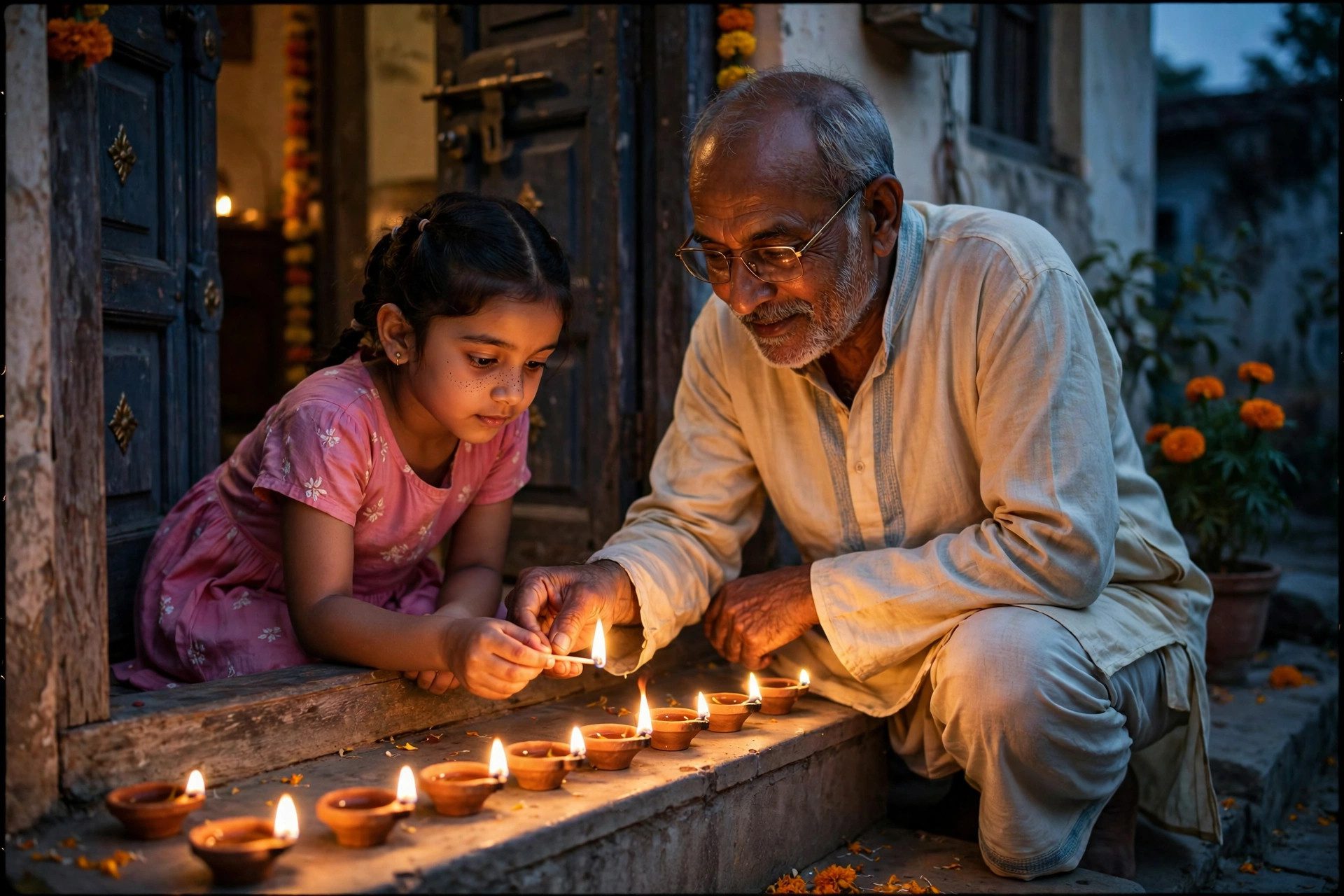
Children ask the questions adults are too polite to ask, and grandparents answer them differently: simpler, funnier, with more of the good bits left in. Give a child one question before the gathering, not a list, and let them ask it in their own words.
- What was the best sweet you got at Diwali, and did you ever steal an extra one?
- Did you ever get in trouble during Diwali? What happened?
- What present did you hope for most, and did you get it?
- If you could show me one Diwali from when you were my age, which one would you pick?
If a child and a grandparent get going, your only job is to stay quiet and keep the recording running. Some of the best family stories we have seen came from a seven-year-old asking a follow-up no adult would have thought of.
Keeping what they say
A phone on the table, recording, beats a perfect setup that never happens. Put it face down near the person talking, mention once that you are recording so the family has it, and then forget about it. Video is fine too, but audio is less intrusive and people relax faster when there is no lens pointed at them.
Catch the extras while you are there. Photograph the recipe card, the old lamp, the house if you are visiting it. Write down the names of people who come up in the stories, with one line on who they were, because a name without that line means little in twenty years.
And if the conversation opens something bigger, the story of a whole life rather than one festival, that is the work we built StoriedLife for. Eva, our AI biographer, has unhurried conversations with your grandparents in their own language (she converses in 50 languages), follows up the way a good listener does, and turns what they say into stories your family can keep and hear read back. You can try a free conversation and see how your grandparents take to it. The questions above work on their own, though. Use them this week either way.
Keep what they tell you. If you would like those answers captured properly, Eva can hold the conversation for you: unhurried, in their own language, and saved as stories in their own voice. Try a free conversation with Eva, or start with 3 free stories.
Frequently asked questions
What are good Diwali questions to ask grandparents?
Start with the senses and the specifics: the house they grew up in, who made which sweet, where they spent their first Diwali away from home, and how the festival changed after the family moved abroad. Grouped questions by theme, like the ones in this post, work better than a long general list, because each answer gives you a natural follow-up.
What questions can kids ask grandparents at Diwali?
Keep it to one question per child and let them phrase it themselves. Good starters: the best sweet they ever got and whether they ever stole an extra one, whether they got in trouble during Diwali, the present they hoped for most, and which Diwali from their childhood they would show you if they could.
Should we ask in English or in our family’s language?
Ask in the language your grandparents think in. Memories tend to return in the language they were formed in, and grandparents often give fuller, more detailed answers in their mother tongue. You can always translate the recording later; you cannot go back and re-ask for the detail that a second language left out.
How do I record the conversation without making it awkward?
Use a phone, face down on the table near the person talking. Say once, plainly, that you are recording so the family can keep it, then drop the subject and let the conversation run. Audio feels less staged than video, and most people forget the phone is there within a few minutes.
Sources
- Drik Panchang, Diwali and Lakshmi Puja dates for 2026, checked November 3, 2026: https://www.drikpanchang.com/diwali/
- StoriedLife, When is Diwali?, checked November 3, 2026.
- StoriedLife, Diwali traditions: the five days, customs and family rituals, checked November 3, 2026.