

It is not the same day as Mother's Day in the United States. Here is the date, why it never moves, and how families mark it.
Día de la Madre is always May 10. The next one is Monday, May 10, 2027.
Mexican Mother's Day is a fixed date. It is May 10 every year, whatever weekday that lands on — unlike Mother's Day in the United States, which is the second Sunday in May and moves.
So in 2027 there are two separate days: Mother's Day in the US on Sunday, May 9, and Día de la Madre on Monday, May 10. Families with roots in Mexico often celebrate both.
One date is fixed, the other floats, so the gap between them changes every year. Día de la Madre 2028 falls on Wednesday, May 10, four days before US Mother's Day on Sunday, May 14. In 2029 it is Thursday, May 10, with the American holiday on Sunday, May 13. Día de la Madre 2030 is a Friday, and in 2031 it lands on Saturday, May 10 — the day before US Mother's Day on Sunday, May 11, which is as close as the two ever get without landing together.
| Year | Día de la Madre (Mexico) | Mother's Day (US) | Same day? |
|---|---|---|---|
| 2027 | Monday, May 10, 2027 | Sunday, May 9, 2027 | No — one day apart |
| 2028 | Wednesday, May 10, 2028 | Sunday, May 14, 2028 | No |
| 2029 | Thursday, May 10, 2029 | Sunday, May 13, 2029 | No |
| 2030 | Friday, May 10, 2030 | Sunday, May 12, 2030 | No |
| 2031 | Saturday, May 10, 2031 | Sunday, May 11, 2031 | No |
| 2032 | Monday, May 10, 2032 | Sunday, May 9, 2032 | No — one day apart |
Highlighted row is the next occurrence. The two holidays last fell on the same date in 2026, when May 10 happened to be the second Sunday in May. That will not repeat until 2037.
They were invented separately, about fifteen years apart, in two different countries.
Anna Jarvis held the first Mother's Day service in Grafton, West Virginia in 1908, in memory of her own mother. She campaigned for years, and in 1914 President Woodrow Wilson signed the proclamation setting the holiday on the second Sunday in May. Because it is defined as a Sunday, the calendar date changes every year.
In 1922, Rafael Alducin, the founder of the Mexico City newspaper Excelsior, ran a campaign calling for a national day to honor mothers, and fixed it on May 10. The first Día de la Madre was held that year and the date has never changed since. It spread quickly through schools and the church, and by mid-century it was one of the most observed days on the Mexican calendar — enough that Mexico City built a monument to it. The Monumento a la Madre, unveiled in 1949, carries the line “A la que nos amó antes de conocernos”: to the one who loved us before she knew us.
Guatemala and El Salvador use the same May 10 date. Most of Latin America does not — see the table further down.
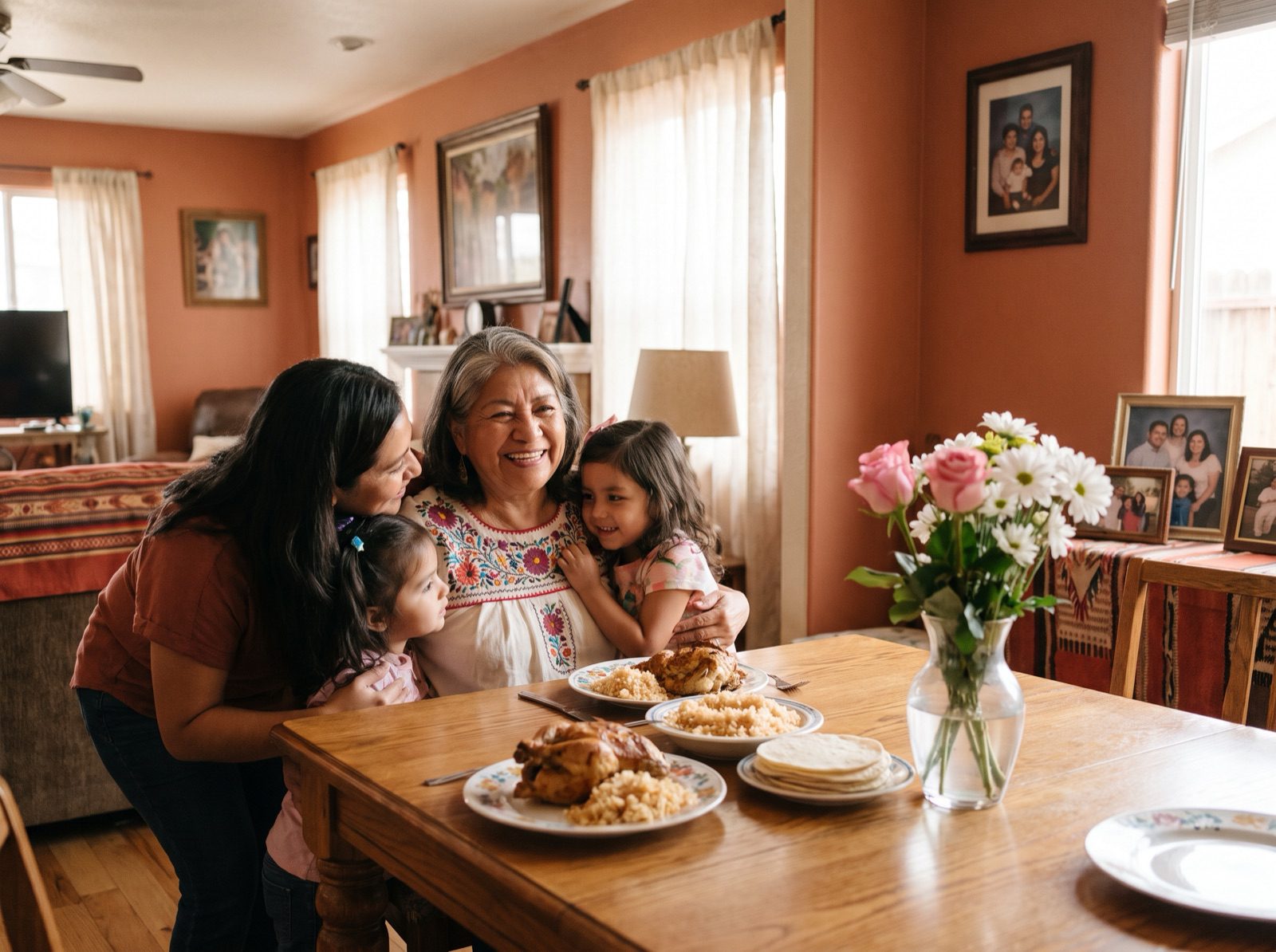
May 10 is a daytime holiday built around the house, not a night out. Whether it falls on a Monday, as it does in 2027, or midweek, as it does in 2028 and 2029, the shape of the day is the same.
Gift-giving on Día de la Madre is real and expected, and it looks a little different from the American version. Flowers are close to obligatory. Beyond that the classics are jewelry, perfume, something for the kitchen (a running family joke in Mexico for a reason), and paying for the meal so she does not have to cook or clean.
The other tradition, which costs nothing, is the one people remember: sitting with her and letting her talk. Día de la Madre in a lot of households is the day the old photo albums come out and someone finally asks who is in them. If your mother or grandmother was born in Mexico and you were not, that conversation is also the only place the family history lives.
About 40 million people in the US are of Mexican origin, and a lot of them run both calendars: the American Mother's Day brunch on the second Sunday, and May 10 for abuela, the call home and the real celebration. Neither one is the “correct” one. Plenty of families simply celebrate twice.
May 10 is Mexican. The rest of the Spanish-speaking world is spread across the calendar.
| Country | When |
|---|---|
| Mexico | May 10 (fixed) |
| Guatemala | May 10 (fixed) |
| El Salvador | May 10 (fixed) |
| Paraguay | May 15 (fixed) |
| Bolivia | May 27 (fixed) |
| Nicaragua | May 30 (fixed) |
| Costa Rica | August 15 (fixed) |
| Panama | December 8 (fixed) |
| Argentina | Third Sunday in October |
| Dominican Republic | Last Sunday in May |
| Spain | First Sunday in May |
| Colombia, Peru, Chile, Ecuador, Venezuela, Puerto Rico, Cuba, Honduras, Uruguay | Second Sunday in May |
Día de la Madre 2027 falls on Monday, May 10, 2027. In Mexico the date never moves: it is May 10 every single year, whatever day of the week that is.
The date never moves, only the weekday does. Día de la Madre 2028 falls on Wednesday, May 10; Día de la Madre 2029 on Thursday, May 10; Día de la Madre 2030 on Friday, May 10; and Día de la Madre 2031 on Saturday, May 10.
Almost never. Mother's Day in the United States is the second Sunday in May, so it moves between May 8 and May 14. Día de la Madre is fixed on May 10. The two only line up in the years when May 10 happens to be the second Sunday, which last happened in 2026 and will not happen again until 2037.
The date comes from a 1922 newspaper campaign. Rafael Alducin, founder of the Mexico City daily Excelsior, called for a national day honoring mothers and set it on May 10. The first celebration was held that year, the date stuck, and it has been May 10 ever since.
No. It is not one of the obligatory rest days in Mexican federal labor law, so shops, offices and factories stay open. In practice it is treated as a major day anyway: schools hold morning festivals, many employers let mothers leave early, and restaurants are booked solid.
In Mexico the usual greeting is ¡Feliz Día de las Madres! In most other Spanish-speaking countries you will hear the singular, ¡Feliz Día de la Madre! Both are correct.
Las Mañanitas is the traditional Mexican song sung at dawn on someone's special day. On May 10 families wake their mother with it, often with a hired mariachi group outside the window, before anything else happens.
Many do. The American Mother's Day on the second Sunday gets the brunch and the school card, and May 10 gets the phone call to Mexico, the mariachi playlist and the family comida. Households with grandparents born in Mexico usually keep May 10 as the real one.
Guatemala and El Salvador share the May 10 date. Most others do not: Costa Rica marks it on August 15, Argentina on the third Sunday of October, Nicaragua on May 30, Bolivia on May 27 and Panama on December 8. Colombia, Peru, Chile, Ecuador, Venezuela and Puerto Rico follow the second Sunday in May.
If the conversation on May 10 is the part that matters, StoriedLife keeps it. An AI biographer named Eva interviews your mother or grandmother over a series of relaxed talks — she just answers out loud, no writing, nothing to learn — and turns what she says into a written, narrated life story the whole family can keep and pass on.
$129.95 a year, digital eBook included free. A printed softcover book is an optional add-on at +$49, hardcover +$69. 30-day money-back guarantee. Interviews are conducted in English.