


By Rafi Moshe, founder of StoriedLife.

The way to preserve your grandparents’ stories is simpler than most families expect: sit down with them, ask about specific moments instead of their whole life, record the conversation, and keep the recording somewhere safer than a phone. Do that a few times and you have the raw material for a book your family will keep. The hard part is not the technology. It is starting before the stories are gone.
Why grandparents’ stories are the first ones a family loses
Your parents can tell you some of it. They can describe the house, the town, the work. But your grandparents are the only people who were actually there for the beginning of the family’s story: why your family left the place it left, what the old country or the old neighbourhood was really like, who the people in the black and white photos were before they were old.
When a grandparent dies, that context goes with them. What survives is fragments. A name on a document. A story your mother half remembers hearing once, with the middle missing. Families usually discover the gap at a funeral, when everyone is asking questions a week too late.
I know this from my own family. Both of my grandfathers died before I could hear their stories from them. My mother’s father, Leon, was close to me until I was six, and he had a bigger effect on my character than almost anyone. I know almost nothing about his actual life. That gap is a large part of why StoriedLife exists.
There is a second reason to do this while your grandparents can still take part, and it is about your kids, not just you. Researchers at Emory University have found that children who know their family’s stories, including the hard chapters, tend to handle difficulty better than children who do not. The stories do something for the generation listening, not only for the one telling. Our guide to preserving family stories goes deeper on that research.
Preserve your grandparents’ stories one conversation at a time
Do not announce an interview. An interview sounds like homework, and it puts your grandfather in the position of a witness being examined. Go for a conversation instead, at the kitchen table or wherever they are comfortable, and keep it short. Thirty to forty minutes is plenty for a first sitting. You can always come back next week, and you should plan to.
The Smithsonian’s oral history guidance, written for exactly this kind of family project, boils down to a few habits that work: pick a quiet place, start with easy questions, ask open questions that cannot be answered yes or no, and do not be afraid of silence. A pause usually means a memory is on its way.
Bring a prompt. Old photographs are the best ones. Put a photo on the table and ask who is in it, where it was taken, and what happened that day. Objects work too: a tool from his workshop, her mother’s recipe card, a uniform, a wedding ring. People who freeze when asked about “their life” will talk for ten minutes about a photograph.
If you want a starting list written for a grandmother or grandfather specifically, our questions to ask your grandma about her life covers childhood, family, work and the lessons she would pass on.
Ask about scenes, not summaries
“Tell me about your childhood” gets you a sentence. “What did your kitchen smell like when you got home from school” gets you a story. The difference is that a scene has somewhere to stand. A few that work well:
- The house or street they grew up in, room by room.
- Their first job, what it paid, and what they bought with the first pay.
- How they met your grandmother or grandfather, told properly, with the parts families usually skip.
- A meal that meant home, and who cooked it.
- The hardest year, and what got them through it.
- Something their own parents said that they still hear in their head.
Then follow up. The follow-up question is where the real material is: “What happened next?” “Who else was there?” “What did that cost, in those days?” Let a detour run. If a question about the war turns into a story about a dog, take the dog story. You are not filling in a form. You are finding out what they actually remember, which is rarely what you would have asked about.
Record it, and keep the original recording
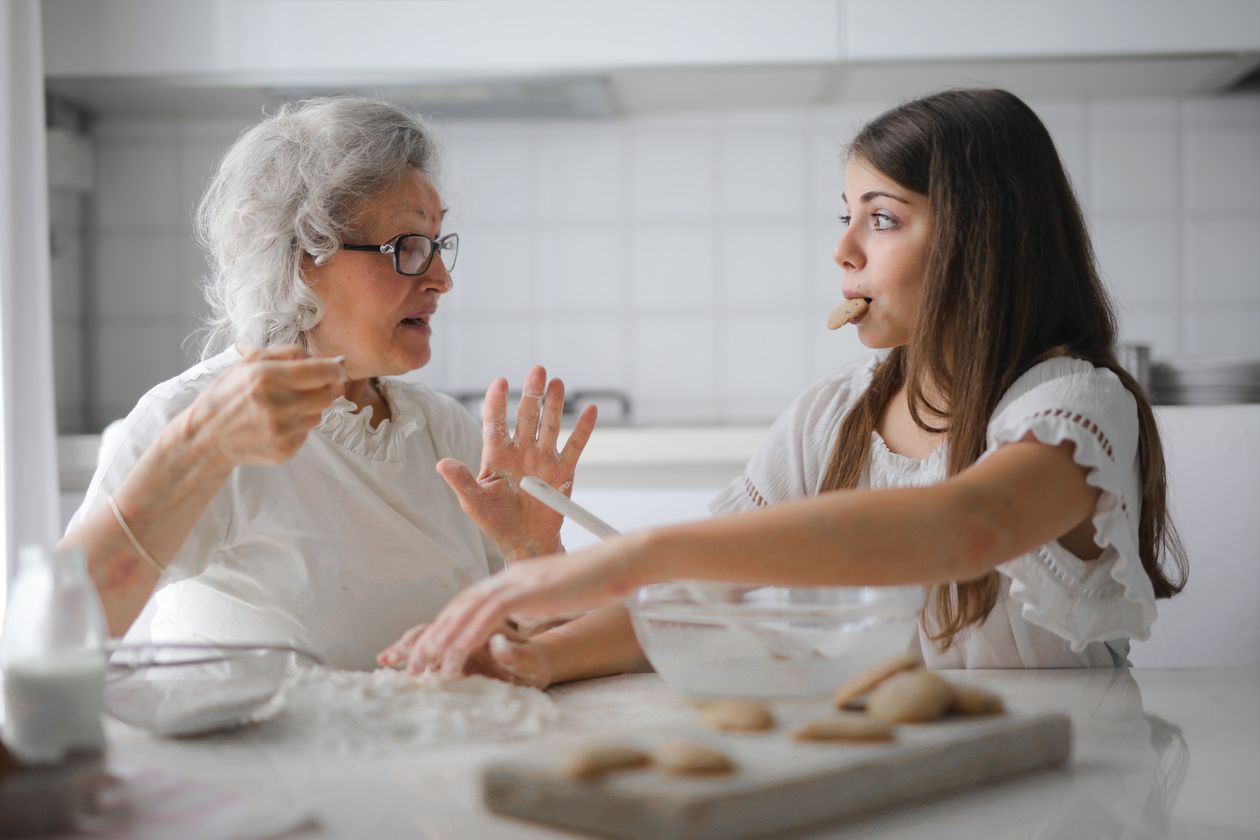
Record every conversation, with their permission, even if you also take notes. Notes capture facts. A recording captures the person: the laugh before the punchline, the pause before a hard memory, the way they say your mother’s name. Twenty years from now, the voice is the part your family will be desperate to hear.
A phone’s voice recorder is fine to start. What is not fine is leaving the only copy on that phone. Phones get replaced, dropped and wiped, and family recordings die with them quietly. The Library of Congress runs a personal archiving program for exactly this reason, and its advice is plain: give files clear names with the person and the date, and keep copies in more than one place. A shared family folder that two people can open is the minimum. Write down who is speaking and when, while you still know.
Keep the original recording even after you have a written version. A transcript is a finding aid. The recording is the heirloom.
Turn the recordings into a book the family keeps
Loose audio files in a shared folder are better than nothing, but most families stop there, and “there” is a folder nobody opens. A book gets opened. It sits in the living room, grandchildren pick it up, and the stories become part of the family’s furniture instead of an archive.
Organise by theme rather than strict chronology. A chapter on the old neighbourhood, one on work, one on how your grandparents met, one on the hard years, one on what they would tell a great grandchild. Chronology matters less than readability, and a theme gives a shy storyteller’s scattered memories a shape.
There are three honest ways to get from recordings to a book:
- Do it yourself. Transcribe, edit and lay it out with a print-on-demand service. Cheapest in money, most expensive in weekends. Expect months, and expect the project to stall at the transcription stage, because that is where almost every family project stalls.
- Use a prompt book. Guided story books, the kind organised around weekly questions, give a grandparent a structure to write into. They work well for a grandparent who likes writing and will actually keep the habit. They do not work for one who will not write, and most of the interviewing and finishing still falls to the family.
- Use a conversation service. This is what we built StoriedLife to be, so weigh this paragraph accordingly. Instead of asking your grandparent to write, Eva, our AI biographer, has a real conversation with them. She asks a question, listens to the answer, and follows up in the moment, the way a good interviewer does. She remembers what they told her last time, so the questions get better. The original recordings are kept and playable in the account, Eva writes and narrates the stories, and the printed book carries a QR code in each story that plays your grandparent’s own voice telling it. How it works walks through the process step by step.
Whichever route you take, decide who gets copies before you print. Siblings and cousins who were not part of the project will want one the moment they see it, and printing extra copies with the first run is always cheaper than reprinting later. Our breakdown of what a memoir book costs shows the real numbers for each route, including ours.
Start with one conversation
You do not need a plan for the whole book this week. You need one conversation, recorded, sometime in the next few days, while the person who can tell these stories is still here to tell them.
If you would like the asking done for you, your grandparent’s first stories with Eva are free, and there is no card to enter. Start a free conversation with Eva and hear how she works before you decide anything.
Frequently asked questions
What if my grandparents say their life was nothing special?
Almost everyone says that, including people who crossed oceans, built businesses or raised six kids in two rooms. It usually means they do not want to perform. Skip the life story framing, ask about one specific thing, a photo, a job, a meal, and let them warm up. The ordinary details are the special part.
What should I ask a grandparent first?
Start with the house they grew up in or their earliest memory of their own grandparents. Both are easy to answer, neither feels like a test, and both open doors. If you want a longer list to pick from, our 100 free questions to ask your parents works just as well for grandparents.
Is a phone recording good enough quality?
For family purposes, yes, if the room is quiet and the phone is close to them rather than across the table. Sit in the same room, turn off the television, and put the phone face down between you so it stops being the focus. Test thirty seconds and play it back before you start properly.
What if my grandparents live far away?
Then a phone or video call is your table. Record the call with their permission, keep the sessions shorter, and go more often. If distance is the reason you cannot run the interviews yourself, a conversation service can do the asking while you stay involved in what comes out of it.
What language can my grandparents tell their stories in?
Whichever one they think in. Stories told in a second language lose the jokes and the sayings first. Eva converses in 50 languages, and for a do-it-yourself project the same rule applies: record in their strongest language and translate later, never the other way round.
Sources
Sources, all checked in October 2026:
- Why family stories matter for children: Emory University, How family stories help children weather hard times, reporting the Emory research on children’s knowledge of family history.
- How to run a good family interview: Smithsonian Institution, The Interview, oral history interviewing guidance.
- How to keep recordings from being lost: Library of Congress, Personal Archiving, guidance on naming, organising and backing up personal digital material.
StoriedLife details (the book up to 300 pages, the QR codes that play the storyteller’s voice, the free first stories) are stated from storiedlife.ai as published in October 2026. Full disclosure: StoriedLife is our product.